Navigating the financial markets requires a clear understanding of the tools at your disposal, which is why quality Trading Education remains the most significant factor in long term success. Whether you are looking at the health of a national economy or the specific movement of an asset’s price on a graph, the method you choose defines your entire approach to risk and reward. This comprehensive guide breaks down the two most popular methodologies, helping you determine how to blend them into a strategy that works for you.
The Core Philosophy of Market Analysis
Market analysis is the process of examining data to make informed decisions about buying or selling financial instruments. At its heart, it seeks to answer one simple question: where is the price going next? To answer this, traders and investors rely on two primary schools of thought.
The first school, fundamental analysis, looks at the “why” behind the movement. It treats an asset like a business or an economy, checking its internal health, growth potential, and external pressures. The second school, technical analysis, focuses on the “what” and “when.” It assumes that all necessary information is already reflected in the current price and that historical patterns tend to repeat themselves.
If you are looking for a community that supports your growth as a trader, our About page outlines our mission to provide unparalleled resources and funding opportunities. Understanding these two frameworks is the first step toward moving away from guesswork and toward a structured, repeatable plan.
Understanding Fundamental Analysis
Fundamental analysis is the backbone of long-term investing and macroeconomic assessment. It involves digging deep into the underlying factors that drive the value of an asset. For a stock, this means reading balance sheets, evaluating management quality, and understanding competitive advantages. For a currency pair, this involves monitoring economic indicators such as interest rate decisions, inflation reports, and unemployment data.
Key Components of Fundamental Evaluation
The goal here is to determine the “intrinsic value” of an asset. If the current market price is lower than the intrinsic value, the asset is considered undervalued, representing a buying opportunity. If the price is higher, it is overvalued.
- Financial Ratios: Metrics like Price to Earnings (P/E) or Return on Equity (ROE) help quantify a company’s performance.
- Macroeconomic Trends: Gross Domestic Product (GDP) reports and central bank policies dictate the broader environment for all assets.
- Qualitative Factors: Brand reputation, corporate governance, and market share play a critical role in long term growth.
When performing this type of research, you are essentially trying to predict future cash flows or economic stability. It is a slow, methodical process that requires patience and a significant amount of research, but it builds a foundation of confidence that short term speculation cannot match.
Related Blog: How to Create a Winning Trading Plan in 7 Steps
Mastering Technical Analysis and Chart Reading
Technical analysis is the preferred language of active traders who focus on price action and market timing. By utilizing chart reading techniques, these traders identify support and resistance levels, trendlines, and candlestick patterns. The core premise is that human psychology fear and greed creates identifiable patterns in historical data.
Essential Technical Tools
Technical analysts do not care about the “intrinsic value” of an asset in the traditional sense. Instead, they look at the interaction between buyers and sellers to forecast the next move.
| Tool Type | Examples | Primary Function |
| Indicators | RSI, MACD, Moving Averages | Identify momentum and trend reversals |
| Chart Patterns | Head and Shoulders, Flags, Triangles | Predict price breakout directions |
| Price Action | Support/Resistance, Order Blocks | Pinpoint exact entry and exit zones |
The beauty of technical analysis is that it can be applied to almost any market, provided there is enough liquidity and price history. If you have questions about how to best apply these technical concepts within a funded account, our Contact page is the place to reach out for direct support.
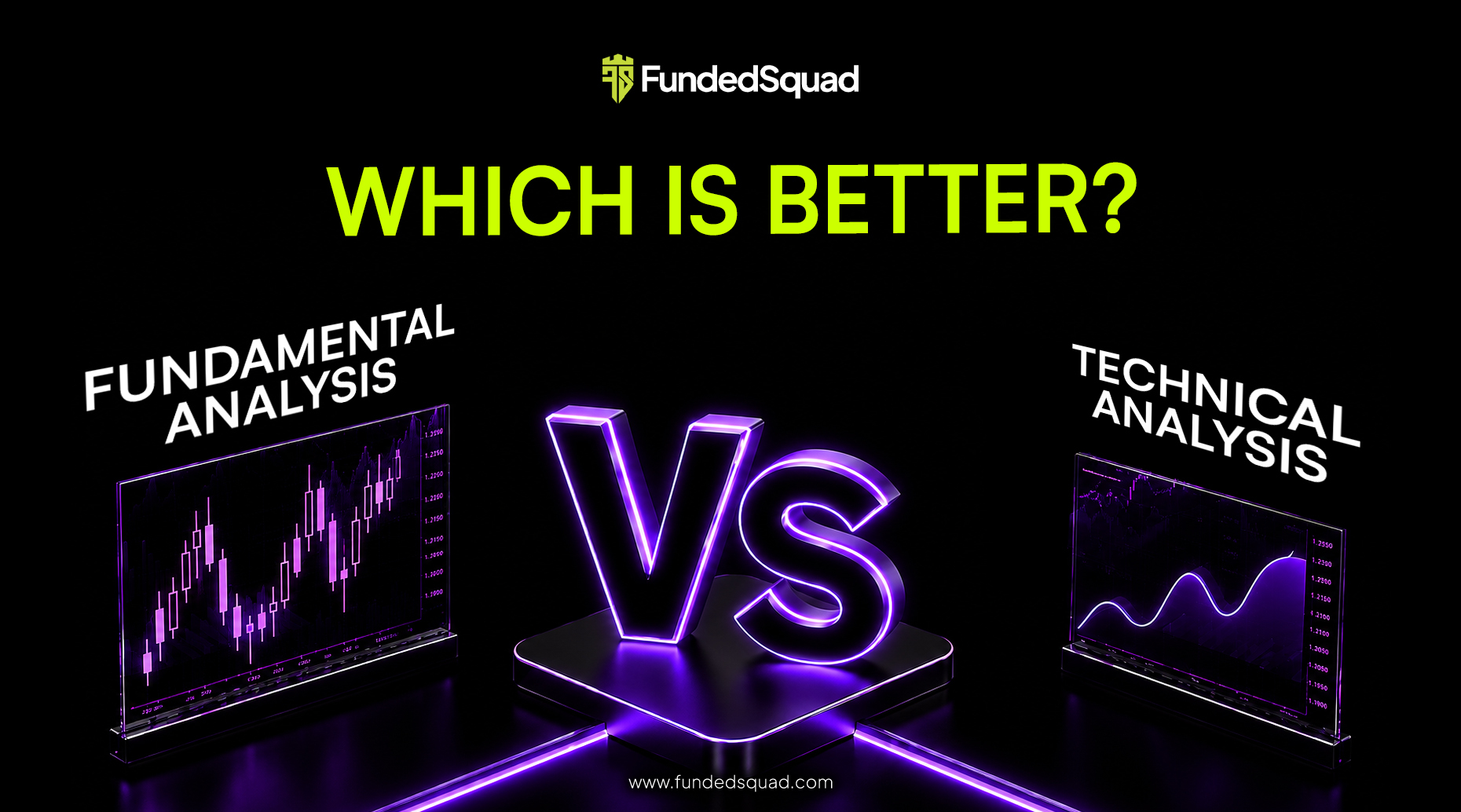
Which is Better? A Balanced Perspective
The debate between fundamental and technical analysis often leads to a false binary. In reality, the most successful market participants often utilize a hybrid approach. They might use fundamentals to identify what to trade looking for strong currencies or undervalued sectors and then use technical analysis to determine when to execute the trade.
Fundamental analysis gives you the “big picture” of whether an asset has the potential to move. Technical analysis gives you the “precision” needed to manage your risk and optimize your entry points. This synergy is what separates consistent performers from those who rely on luck.
We believe that professional growth is a partnership, which is why we encourage you to check our Partner program to see how we align our interests with your success. By combining these methodologies, you minimize the risk of being caught on the wrong side of a major news event while ensuring you are not buying at a point of technical exhaustion.
Leveraging Your Edge
At Funded Squad, we understand that your growth as a trader is paramount. With 30k+ active traders and over 2M+ performance rewards distributed, our community has seen every type of analysis in action. Whether you lean toward the macro data of the fundamentals or the precision of the technical charts, the real edge comes from your ability to execute your plan consistently.
Our platform offers:
- No consistency rules: Trade the way that fits your personality.
- Rewards on demand: Access your profits when you earn them.
- Reward split up to 100%: You keep the vast majority of what you create.
- No Time Limit: Remove the pressure of artificial deadlines.
- No withdrawal threshold: Your earnings are your own.
Frequently Asked Questions
Is technical analysis better than fundamental analysis for day trading?
For day trading, technical analysis is generally superior because it focuses on short-term price fluctuations and momentum, which are driven by market sentiment rather than long-term corporate earnings.
Can you combine both methods in one strategy?
Yes, many professional traders use fundamental analysis to identify the trend or market bias and technical analysis to find the exact entry and exit points to maximize their risk to reward ratio.
What are the main risks of relying solely on technical analysis?
Technical analysis does not account for unexpected “black swan” events or major shifts in government policy, which are usually captured by fundamental data.
How long does it take to learn these analysis techniques?
The duration depends on your dedication, but most traders spend several months to years mastering the nuances of chart patterns, economic indicators, and risk management.
Do I need a lot of money to start applying these analysis methods?
You do not need a large capital base to practice analysis. Many traders begin with demo accounts or join funded programs like Funded Squad to apply their skills with professional-grade capital.
Conclusion
Choosing between fundamental and technical analysis is not about picking a winner; it is about finding the tool that matches your individual trading style and goals. While fundamental analysis offers a deep, long-term look at value, technical analysis provides the actionable data needed for precise execution. Ultimately, the best path for your Trading Education is one that emphasizes consistency, risk management, and the flexibility to adapt to changing market conditions. By mastering these skills and utilizing the right environment, you can build a sustainable and rewarding career in the markets.