Ask any experienced trader what separates profitable traders from everyone else. They won’t say entries. They won’t say indicators. Almost every time, the answer comes back to one thing: how they manage risk, specifically, how they set their stop losses.
This is where most trading education falls short. You’ll find hundreds of guides on entries. Very few explain the actual logic behind good stop placement. So traders guess. They put stops in obvious places, get swept out by normal price movement, and then blame the market.
This guide changes that. We’re going to walk through the real science of stop losses, the methods that funded traders actually use, the psychology behind why most traders do it wrong, and a practical framework you can apply right away.
What a Stop Loss Actually Does (And What It Doesn’t)
A stop loss is not a fear-based tool. That’s the first mindset shift you need to make. Most beginner traders treat stop losses like a panic button, something you set just in case things go badly. That framing leads to poor placement every time.
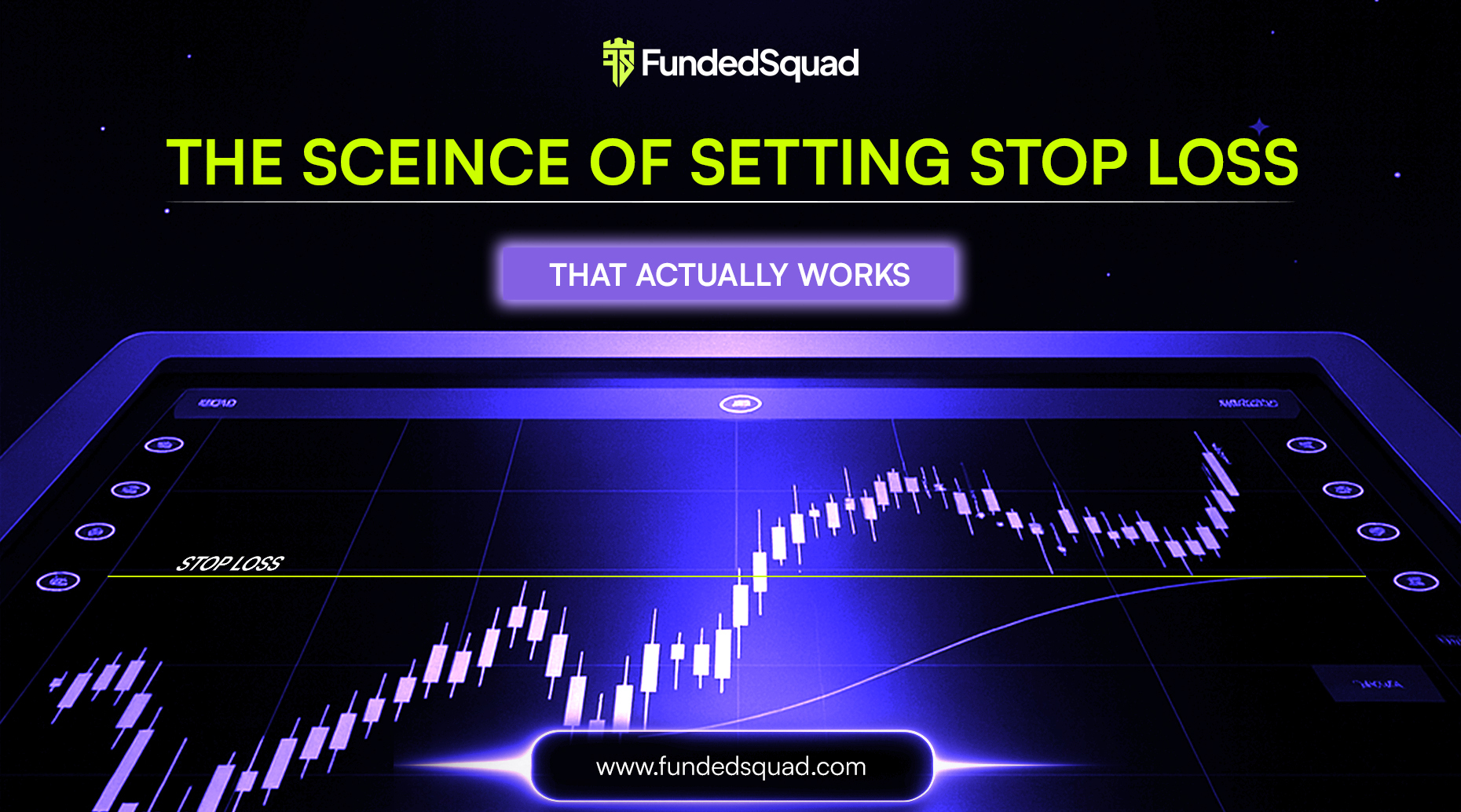
A stop loss is a risk parameter. It defines the exact point where your trade idea is proven wrong. Not where you’re uncomfortable. Not a round number that feels safe. The exact structural point where, if price reaches it, your reason for entering no longer exists.
That distinction is important. Proper trading education on stop losses always starts here, with the understanding that a stop is a logical boundary, not an emotional one.
Three Stop Loss Methods That Professional Traders Actually Use
There’s no single perfect method for every trade. But three proven approaches consistently outperform random or emotion-based stop placement. Here’s how each one works in practice.
Method 1 – Structure-Based Stop Placement
This is the most reliable method in all of price action trading. You place your stop beyond a clear market structure, a swing high, a swing low, or a significant support and resistance level.
The logic is simple: if price breaks that structural level, the trade idea is invalid. You’re not guessing where to put the stop, the market structure is telling you.
✦ Example: You buy at a support level. Your stop goes just below the most recent swing low. If that level breaks, buyers are clearly not in control.
Method 2 – Volatility-Based Stops (ATR Method)
Volatility-based stops use a tool called the Average True Range (ATR) to measure how much the price typically moves in a given period. Your stop is placed at a multiple of that value, usually 1.5x or 2x ATR, beyond your entry.
This is especially useful in fast-moving markets like indices or commodities. It prevents you from stopping out too close to the price during naturally volatile sessions, which is one of the main reasons traders get stopped out unfairly.
✦ If the daily ATR on EUR/USD is 60 pips, a 1.5x ATR stop would be 90 pips from entry. It gives the trade room to breathe without excessive risk.
Method 3 – Trailing Stops for Open Profit Protection
Trailing stops move with the price as a trade goes in your favour. Instead of a fixed exit level, the stop follows price at a set distance, locking in gains while still giving the trade room to continue running.
This is one of the most effective exit strategies for trend-following trades. It removes the need to manually decide when to take profit, the market takes you out only when it reverses.
✦ Best used after a trade has already moved in your favour. Don’t trail from the very start, give the trade room to develop first.
Why Traders Set Bad Stop Losses
Most bad stop placement decisions come from one underlying emotion: the fear of being wrong. It sounds counterintuitive, but stay with it.
The Wide Stop Trap
When a trader sets a very wide stop, it feels safer. The logic goes: “If I give it more room, it won’t stop me as easily.” But what actually happens is that a wide stop creates enormous risk relative to the potential reward. You’re not trading smarter, you’re just risking more to avoid the discomfort of being stopped out.
The Tight Stop Trap
On the other side, some traders set extremely tight stops because they want to risk as little as possible per trade. The result? Normal, healthy price fluctuation hits their stop before the trade even has a chance to work. They’re not wrong about the direction, they’re just too close to the noise.
Good risk parameters sit between these two extremes. They respect the market’s natural movement while still defining a clear invalidation point. That balance is what proper trading education on stop losses is built around.
Stop Loss Do’s and Don’ts: The Clearest Summary You’ll Find
Do This:
Base your stop on market structure
Use ATR to account for volatility
Set your stop before you enter the trade
Trail your stop after profit builds
Size your position around your stop distance
Accept the stop as part of the trade plan
Avoid This
Moving your stop further away mid-trade
Placing stops at round numbers randomly
Making stops too tight to avoid large losses
Setting stops without checking the ATR
Removing stops entirely “just this once”
Basing stops on how much you want to lose
Stop Loss Sizing: Matching Risk Parameters to Account Rules
For prop firm traders especially, understanding how stop placement relates to account risk parameters is non-negotiable. Getting stopped out too frequently without a plan will erode your account and your evaluation standing quickly.
Here’s a simple guide to thinking about stop size relative to account drawdown limits:
| Trade Risk Per Trade | Daily Loss Limit (3%) | Max Losing Trades/Day | Assessment |
| 0.5% per trade | 3% of the account | Up to 6 losses | Conservative ✔ |
| 1% per trade | 3% of the account | Up to 3 losses | Balanced ✔ |
| 2% per trade | 3% of the account | 1–2 losses max | High risk ✘ |
| 3%+ per trade | 3% of the account | One loss ends the day | Dangerous ✘ |
At Funded Squad, the daily drawdown limit across accounts is 3%. Keeping individual trade risk at 0.5%–1% gives you enough room to have normal losing days without breaching that limit. This is the kind of structured thinking that keeps funded traders in the game long-term.
A Simple Pre-Trade Stop Loss Checklist
Before you enter any trade, run through these five questions. It takes less than sixty seconds and dramatically improves the quality of your stop placement every time.
Where is the nearest structural level that invalidates my trade idea? This is your stop anchor.
What is the current ATR on this timeframe? Make sure your stop respects natural volatility.
How much of my account am I risking on this trade? It should be 0.5%–1% maximum.
Does my potential reward justify this risk? Aim for at least a 1:2 risk-to-reward ratio.
Will I move this stop if the price moves against me? Decide now. The answer should always be no.
Final Thoughts:
The hardest part of trading education on stop losses is accepting that losses are part of the process. A stop loss that gets hit isn’t a failure. It’s your risk management working exactly as intended.
The traders who last in this industry aren’t the ones who avoid losses. They’re the ones who define their losses in advance, keep them small, and never let a single trade threaten their entire account. That discipline, more than any strategy or indicator, is what separates consistent traders from everyone else.
Set your stops before you enter. Base them on structure and volatility. Size your positions around them. And treat every stopped-out trade not as a failure, but as a plan executed.